
Home > SPORTS > The Digital Twin: Real-Time Data Science in Sport
SPORTS
The Digital Twin: Real-Time Data Science in Sport
01 INTRODUCTION: THE INVISIBLE GAME
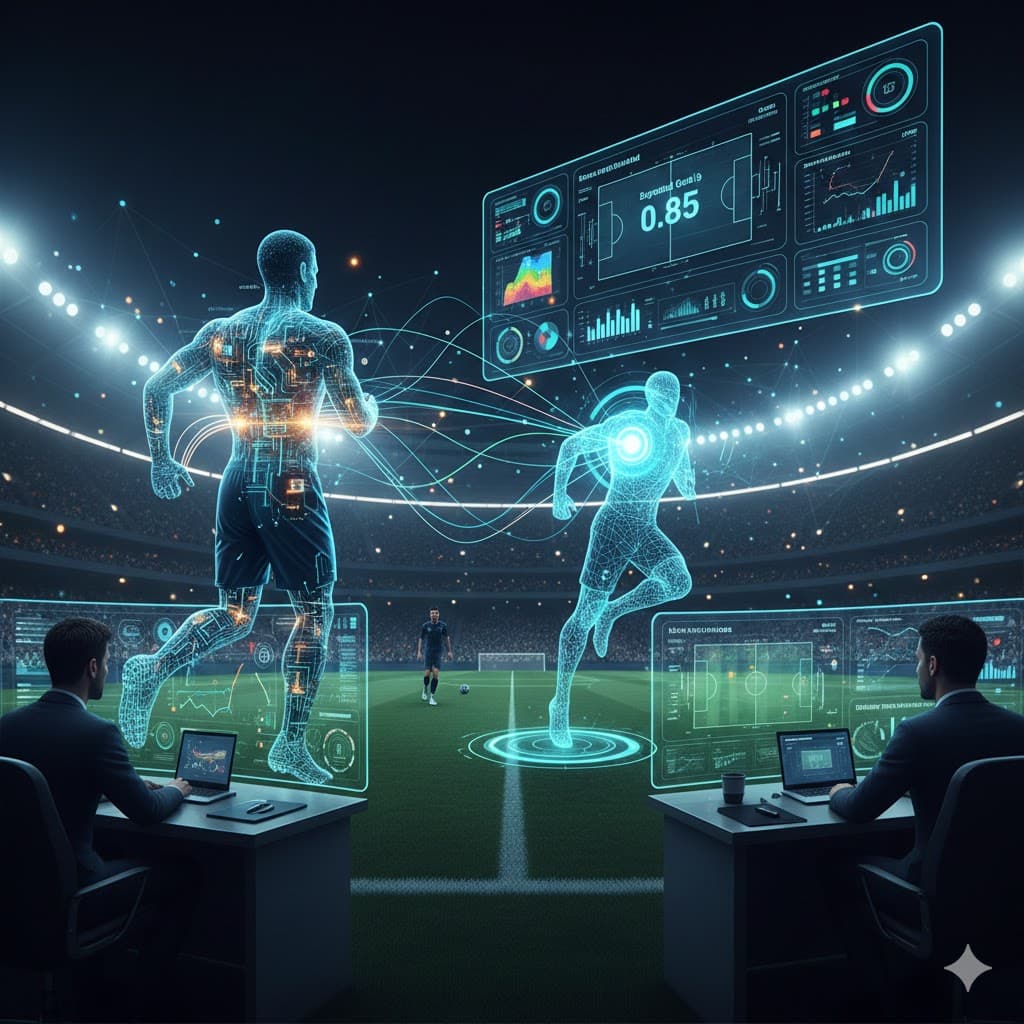
Beyond the jersey and the grass lies a second, invisible game played entirely in binary. Every time a player moves, they generate a trail of digital breadcrumbs. In modern sports, the "Data Science" approach isn't just about recording history—it's about building a Digital Twin of the athlete.
We are no longer just watching a match; we are running a live simulation that allows us to predict performance, preempt injury, and optimize tactical "If/Then" scenarios before they even unfold on the pitch.
02 THE PHILOSOPHY: DATA AS A SENSORY EXTENSION
My core philosophy for this project is that Context is the ultimate variable. A player running at 30km/h is just a number. But that same speed recorded in the 85th minute, while trailing by one goal, is a data point that tells a story of elite conditioning or sheer desperation.
Data science in sports is the art of turning raw, chaotic metrics into situational intelligence. We move from Descriptive Analytics (What happened?) to Predictive Modeling (What will happen next?). We are essentially building a high-fidelity map of human potential.
03 THE INFRASTRUCTURE: THE CONNECTED ATHLETE
To build a Digital Twin, you need an aggressive and precise ingestion layer. This is where hardware meets human biology.
- Wearable Telemetry: Modern athletes wear GPS units between their shoulder blades that track positional data 10 times per second and heart rate variability in real-time.
- Computer Vision: High-speed optical cameras triangulate the X/Y/Z coordinates of every player and the ball, creating a 3D skeletal map of the entire event.
- The Logic Engine: This data is fed into a pipeline that cleans the "noise"—the sensor glitches and hardware errors—to create a smooth, digital mirror of the physical game.
04 THE ARCHITECTURAL LAYER: PITCH CONTROL & VALUE
The "Digital Twin" approach allows us to see things the human eye is too slow to process. We use algorithms to calculate Pitch Control, which determines exactly who "owns" every square inch of the field at any given millisecond based on their current velocity and momentum.
We also move toward Action Valuation. Instead of just counting a pass, the system evaluates how much that pass increased the team's probability of scoring. It identifies the "Silent Heroes"—the players whose movements create space even when they never touch the ball.
05 THE "WHAT IF": SIMULATING REALITY
The most powerful aspect of the Digital Twin is the ability to handle the "What If." We can take a real-world scenario—like a failed defensive line—and run it through a logic engine 10,000 times to see which tactical adjustment would have produced the best outcome.
This isn't just theory; it’s an Adaptive Recovery System. If a key player is injured, the Digital Twin allows coaches to simulate how the entire team’s "System" will shift, identifying which node in the network needs to step up to maintain the structural integrity of the formation.
06 CONCLUSION
Ultimately, the integration of Data Science into sports is not about replacing the human element; it is about honoring it through precision. By building a Digital Twin, we acknowledge that every sprint, every tackle, and every decision is a data-rich event that deserves to be understood.
Whether I am architecting a database for a corporate project or building a performance model for a sports team, the goal remains identical: to reduce the margin of uncertainty. We use logic to shine a light on the patterns hidden in the chaos of the game. When you master the data, you don't just watch the sport—you anticipate its future.
Master the signal, ignore the noise, and you master the outcome.